Pot-Limit Omaha Starting Hands You Should Never Fold

What is certainty in a game of four cards? The ancient question returns: which hands justify commitment before the unknowable flop reveals itself?
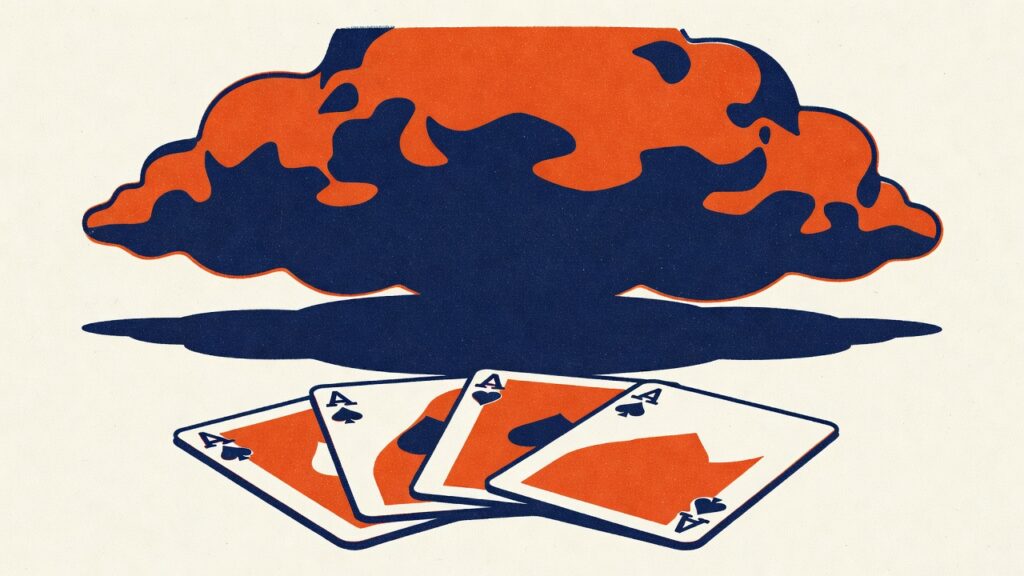
PLATE. Four hole cards in envelope-style deal position with flop uncertainty looming ahead.
One might ask: in Pot-Limit Omaha, where each player receives four hole cards instead of two, which hands carry sufficient value to play in any position? The answer requires thinking about probability, hand equity, and what philosophers once called “justified belief” in an uncertain outcome.
Double-Suited Aces in Omaha
Consider first the hand we might call the highest authority: A-A-K-Q, where the aces are of different suits, and the king and queen are of different suits (known as “double-suited” in Omaha parlance). This hand belongs in every pot, from early position to the button. Why? An ace-high holding provides dominion over other hands. The equity advantage of A-A-K-Q against a random four-card selection is approximately 58 percent. Against a tight range, it climbs past 62 percent. In Omaha, where hands move from mediocre to strong with the turn card, such early advantage rarely shrinks. One might say it’s not a question of “should you play this hand,” but rather: “can any sensible hand-ranking exclude it?”
When the aces are double-suited (both suited to different cards), the value increases further. A-A-K-K double-suited, for instance, makes both flushes and pairs simultaneously. The probability of flopping a flush draw or a made hand sits near 40 percent in this specific case. The public raises; you call or reraise. Action flows naturally to stronger terrain.
Kings and Queens in Harmony
K-K-Q-Q double-suited presents a different proof. Here we find neither ace nor top kicker, yet the hand holds logic. Two pair possibilities abound. Flush draws emerge readily. The equity against a random hand approaches 50 percent, and against a tight opening range, climbs toward 56 percent. Position matters less; this hand belongs in most pots before the flop.
Why not simply fold and wait for aces? Because Omaha rewards action, and waiting for the highest hand is to confuse patience with cowardice. K-K-Q-Q teaches a lesson: in a four-card world, hand strength distributes more widely. Second-best holdings have merit.
The Question of Connectedness
One might ask: what of hands like 9-9-8-8 double-suited, or 9-9-T-J double-suited? These fall into the category of what players call “medium pairs with side action.” The pair provides showdown value. The side cards offer draws. But equity against a range drops to 45-48 percent. Should you play them?
The answer depends on position and table conditions. In late position, yes. You collect sufficient dead money from blinds and antes to justify the lower equity. Under the gun or on the button when action is tight, no. You are not obligated to play because cards exist; you are obligated to find advantage. This hand against a strong opener has neither.
Broadway Hands and the Straight Story
A-K-Q-J, all different suits, sits at the edge of reason. It has no pair, no flush draw beyond the single cards. Yet many players will not fold it. They see “broadway,” all face cards, and imagine made straights. One must examine this carefully. A-K-Q-J equity is approximately 42-44 percent against a range of strong hands. Against a single opponent in the blinds with a random hand, 52 percent. The context matters entirely.
In a four-card game, a hand without a pair or a meaningful draw lacks the structural integrity to survive implied odds. Straight possibilities are tomorrow’s problem; today’s problem is that you have bottom equity and poor position. If someone has opened strongly ahead of you, folding is wisdom, not cowardice.
The Discipline of Exclusion
One final consideration: which hands do you never play, regardless of position? Hands with three or four disconnected low cards (7-6-4-3, 9-5-3-2) have no mathematical defense. They block your own straights. They produce weak pairs that lose to higher pairs. They offer neither flush nor straight draw with much vigor. The equity is simply too low. Better to fold and preserve capital than to convince yourself that “anything can flop.”
The ancient philosophers argued about the nature of necessary truth. In Pot-Limit Omaha, the necessary truths are these: high pairs need little justification; connected hands with multiple draws justify entry; low-card hands without structure do not. Position modulates these principles, but does not overturn them.
Play A-A, K-K, Q-Q, and top-quality side cards. Play double-suited combos that flow toward straights and flushes. Fold hands that lack both. This is not a strategy of avoiding fun; it is a strategy of finding hands where the odds are your ally, not your enemy.
What other question is there to ask?